
Peptide protocols exist to guide, organize, and direct the appropriate use of a given compound, taking into account specific objectives, individual characteristics, and important technical criteria.
Just as with any health-related matter, it is not enough to simply know a product or understand what it is used for — planning, monitoring, and responsible guidance on the correct method of use are essential. In the same way that you should not use a medication without proper medical guidance — even if you know its formula or purpose — peptides also require caution and individualized analysis.
Before recommending any approach, a qualified professional considers factors such as lab results, physical condition, medical history, specific needs, and potential risks involved. After all, every body responds differently, and health-related decisions should never be based solely on surface-level information, third-party recommendations, or promises of quick results.
Throughout this article, we will explore what a peptide protocol truly is, what its main purpose is, and why it becomes an essential element in any use, study, or application involving peptides intended for in vitro research. Read on and understand the importance of this process.
What Is a Peptide Protocol and What Is Its Purpose?

First and foremost, every lyophilized in vitro peptide is primarily intended for laboratory scientific research. In the context of using lyophilized peptides — such as Retatrutide and other research compounds — a protocol is a document or structured set of guidelines that defines, with precision:
- How.
- How much.
- When.
- And under what conditions…
…a given compound should be used.
A peptide protocol is therefore not a simple recipe or informal usage suggestion. A well-structured protocol brings together important technical, clinical, and logistical information into a single coherent guide — built from available scientific evidence and tailored to the profile of whoever will be using it.
A well-structured peptide protocol should contain:
- Compound identification — name, quantity, batch number, and origin
- Reconstitution method — type of solvent, volume to be used, and correct dilution technique
- Dosage — amount per application, unit of measurement (mcg or mg), and calculation method
- Frequency and duration — how many times per week, for how many weeks, and whether rest cycles apply
- Route and technique of administration — subcutaneous, intramuscular, injection site, and rotation points. Subcutaneous is the most common.
- Storage conditions — temperature before and after reconstitution, shelf life after dilution
- Inclusion and exclusion criteria — who can or cannot use it, considering pre-existing clinical conditions
- Monitoring and follow-up — recommended tests before, during, and after use
- Expected adverse effects — what is considered normal, what requires attention, what indicates immediate discontinuation, and what results are expected in the short, medium, and long term
The primary purpose of a protocol goes far beyond organization. It exists for three fundamental reasons:
1. Safety. Lyophilized peptides are biologically active compounds — meaning they directly interfere with physiological processes in the body. Without a protocol, the risk of underdosing (rendering the use ineffective), overdosing (causing adverse effects), or improper use (compromising the integrity of the compound) is high.
2. Reproducibility. A protocol ensures that observed results can be attributed to the compound itself — not to external variables such as dilution errors, improper storage, or irregular use frequency. This is especially relevant in research settings.
3. Accountability. Having a documented protocol means that use is grounded in rational criteria — not random experimentation or informal suggestions. It is what differentiates a serious, informed approach from impulsive and potentially harmful use.
In summary: a protocol is the mandatory starting point for anyone — professional or otherwise — who intends to work with or use peptides seriously. Without it, even the most promising compound on the market loses its predictability — and what should be a tool for improving your health becomes an unknown and potentially dangerous variable.
How Do You Obtain a Peptide Protocol?

At this point, you already understand the importance of having a structured protocol before beginning any peptide use. The question that naturally follows is: how do I obtain a protocol that truly fits my profile, needs, and goals?
This is a point that requires extra care.
There is a growing number of people, websites, WhatsApp groups, and even peptide suppliers offering “ready-made protocols” for the most varied purposes — weight loss, aesthetics, muscle performance, and more. The problem is that a ready-made protocol, by definition, does not exist. What exists are general guidelines that must necessarily be adapted to each individual’s reality.
This is because the safe and effective use of a lyophilized peptide involves far more than simply following a generic dosage. It is essential to consider:
- The correct method of transport, handling, and reconstitution of the compound — errors at this stage compromise the stability and efficacy of the peptide before the very first application
- The appropriate quantity for the intended objective and duration of use
- The individual clinical profile, which includes factors such as:
- Age
- Degree of overweight or obesity
- Pre-existing conditions
- History of allergies
- Sensitivity or resistance to certain compounds
- Concurrent use of medications or other compounds
All of these elements directly influence how the body responds to the peptide. Therefore, a protocol developed for one person may be completely unsuitable for another — even if both share the same goal. Results may not appear, may take far longer than expected, or worse: avoidable adverse effects may arise.
The conclusion is straightforward: be wary of any source that offers a generic protocol as if it were a universal solution. A serious protocol starts with the individual — not the compound.
As a strong recommendation: seek medical guidance and obtain relevant lab work before acquiring any peptide or following any protocol you may be offered.
LinkChinaPeptides: Your Trusted Bridge to International Manufacturers
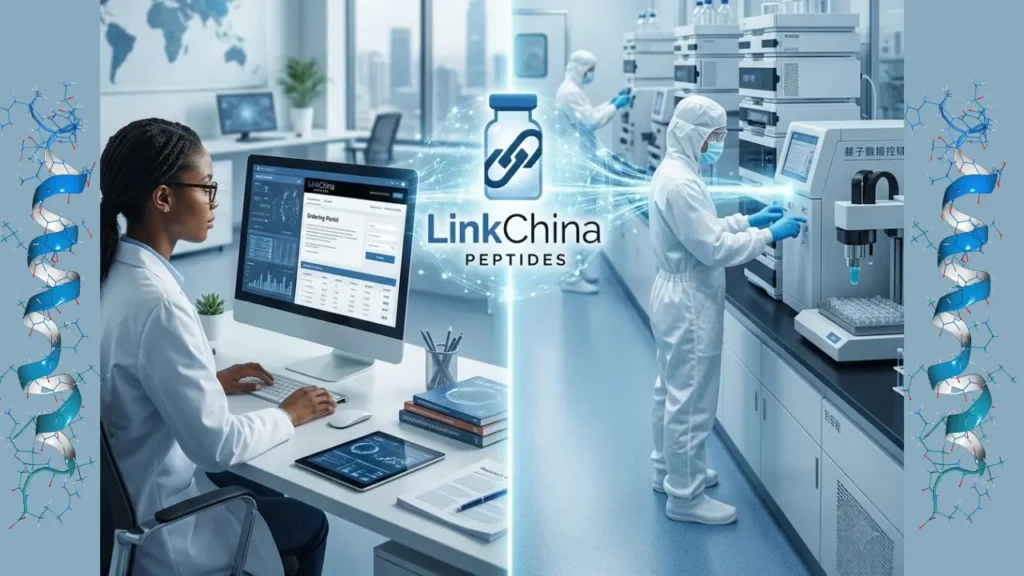
LinkChinaPeptides connects researchers, professionals, and interested parties directly with specialized manufacturers in China, offering strategic support, technical information, and guidance throughout the entire intermediation process.
However, no legal representative of LinkChinaPeptides is authorized to indicate, provide peptide use protocols, or make any recommendations in that regard.
LinkChinaPeptides is fully focused on transparency, confidentiality, and access to carefully selected suppliers — helping and connecting those who seek a deeper understanding of the peptide market intended exclusively for scientific and laboratory research with leading manufacturers in China.
Learn more about LinkChinaPeptides. Click HERE to learn more