
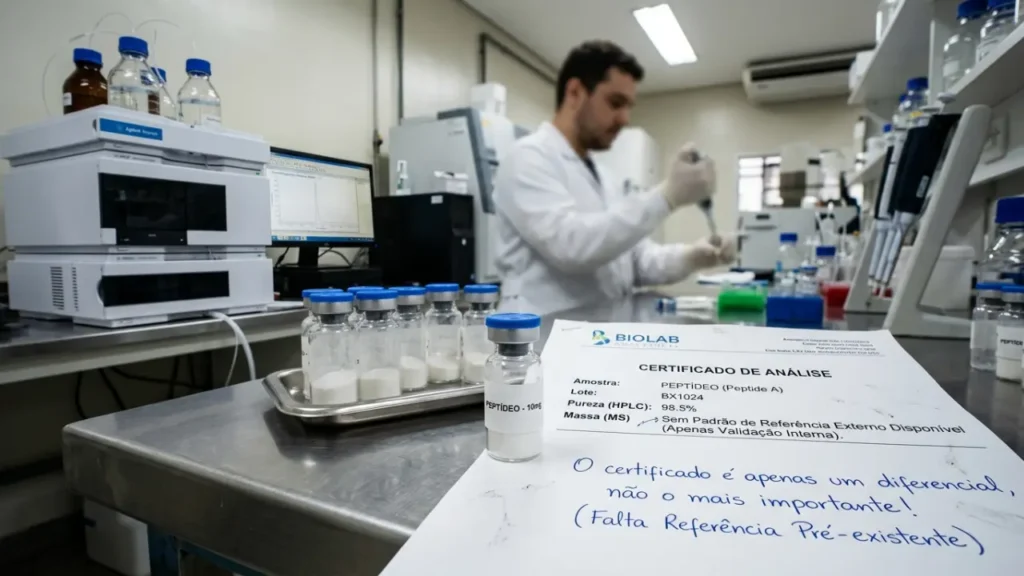
When purchasing peptides, one of the first things that usually draws attention is the COA (Certificate of Analysis). There is extensive literature on peptides emphasizing the importance of this certificate, as it supposedly verifies the product’s purity, validity, and compliance, whether intended for research purposes or other applications.
For this reason, buyers commonly try to confirm whether a website, laboratory, or supplier can provide the well-known COA. Many people, in fact, do not fully understand how to interpret this type of document, yet they believe that the absence of a COA is a strong indication of a questionable product. But is that really the case?
In this article, we will take a closer look at what a COA is, whether it is truly indispensable — or simply an important differentiator — and how to interpret this certificate correctly. Follow along.
The Central Misconception: A “Reference Standard” Is Not Just One Thing
To certify any product and claim that it is authentic and meets the expected technical criteria, a reliable reference is required as a basis for comparison. The famous Coca-Cola formula, for example, has never been officially disclosed and remains an industrial secret.
But imagine, hypothetically, that Coca-Cola decided to make its recipe public, detailing the exact amounts of caffeine, water, coloring agents, sugars, and all other components present in the formula. In that scenario, any manufacturer attempting to reproduce the product would need to strictly follow those specifications for its version to be considered equivalent to the original.
In other words, for a product to be technically certified or validated, it must present composition, characteristics, and parameters compatible with the reference used as the standard. Up to this point, the concept is straightforward and easy to understand.
However, this is not exactly how things work with peptides. In their case, two fundamentally different concepts are often merged into one:
- Certified Reference Standard (CRS).
A certified reference standard is an authentic sample that has been officially characterized and is traceable to a recognized authority such as the USP, EP/Ph. Eur., or NIST. These standards exist for established pharmaceutical compounds and allow direct comparison for identity and quantification. - First-Principles Analytical Characterization. This refers to confirming a molecule based on its intrinsic physicochemical properties, without requiring an external authentic sample for comparison.
Eli Lilly and Company has already indicated its intention to pursue regulatory submission for obesity and overweight treatment indications throughout 2026 (see the article “Retatrutide: The New Weight Loss ‘Miracle’? Discover the Truth Behind the Impressive Results”) through the peptide Retatrutide.
This means that Eli Lilly possesses the authentic GMP-grade material. However, there is currently no official pharmacopeial monograph and no commercially available CRS for Retatrutide. Therefore, the real question becomes: what remains as a reference for a compound that is still under development?
The answer is: the reference is theoretical, not physical.
For a developmental peptide such as Retatrutide, the laboratory’s “reference” is not a real sample originating from Lilly — it is a theoretical value calculated from the published molecular structure and amino acid sequence available in patents and scientific literature, which remain publicly accessible even for compounds still in development.
In other words, using Retatrutide as an example, it is reasonable to state that no COA issued by any laboratory, supplier, or manufacturer in the world can be considered a truly definitive validation for this peptide. At best, such COAs represent a theoretical analytical reference rather than confirmation against an official authenticated standard.
Theoretical Reference, Not Physical. What Does That Mean?

In practice, this means:
• Identity by mass (MS/HRMS):
The expected monoisotopic or average mass is calculated based on the molecular formula and then compared with the observed mass (in the case of our example, Retatrutide, which appears in multiple charged states, z = 3–7). The comparison is made against a theoretical value, not against an authentic reference vial, precisely because such a reference does not yet officially exist.
• Sequencing by MS/MS (peptide mapping):
The peptide is fragmented, and the fragmentation pattern is analyzed to determine whether it matches the expected sequence. This is considered one of the strongest forms of identity confirmation and does not require a physical reference standard.
• Amino acid analysis (AAA):
The peptide is hydrolyzed, and its amino acid composition is compared against the expected theoretical composition.
From an identity standpoint, these methods are reasonably robust. They allow analysts to state, with good confidence, that the molecule is structurally compatible with the published Retatrutide sequence. Again, the key word here is “compatible.”
So where is the Achilles’ heel in this discussion, and why should COAs still be viewed with some skepticism? This is where caution becomes justified. Three major limitations become especially evident in the absence of a real and certified CRS:
- Chromatographic purity is relative, not absolute.
A result such as “≥99.0% by RP-UHPLC” refers to area percentage — meaning the proportion of the main peak relative to the total detectable peak area — not necessarily the true purity of the product itself. UV detectors only “see” substances that absorb light at the selected wavelength, while mass detectors only detect compounds capable of ionization. Counterions (such as TFA or acetate), water, residual salts, solvents, and non-chromophoric impurities may remain invisible to the analysis. As a result, a product may show 99% “chromatographic purity” while still containing significantly less actual peptide material in the vial, which can affect the product’s appearance after lyophilization, as well as its consistency and overall performance. - Net content is the weakest point.
“How many milligrams of actual peptide are truly present in the vial?” is a completely separate measurement from purity. With a certified reference standard, quantification can be performed through direct comparison. Without one, laboratories must rely on substitute methods such as AAA, quantitative NMR (qNMR), sequence-derived extinction coefficients, or nitrogen analysis — all of which involve assumptions and noticeable margins of error. This is precisely where the lack of a certified reference standard becomes most problematic, and it is also the value most frequently estimated or inherited rather than rigorously measured. In theory, with or without a COA, the peptide “X” you purchased may not actually contain sufficient quantities of the real peptide “X.” - Isobaric species.
Identical mass does not necessarily guarantee an identical sequence. If the COA only confirmed molecular mass without performing sequencing or peptide mapping, a different sequence possessing the same mass could go completely undetected. This becomes another critical concern, especially considering that most COAs do not include peptide mapping analysis.
The Sweet Illusion of Traceability

Finally, the term “traceability” deserves a more careful interpretation. A lot number, QC tracking code, or batch number does provide internal traceability — meaning the vial can be linked to that laboratory’s own testing records. However, this is not the same as external validation against an authorized and absolute reference standard for that compound.
For a developmental compound, such a public external truth simply does not yet exist. And most in vitro research peptides fall precisely into this category: developmental compounds. In practice, the laboratory ultimately becomes either self-referential (comparing results against its own methods and internal standards) or theoretically referential (comparing results against the published molecular sequence).
Using Retatrutide as an example once again, neither of these approaches represents a true comparison against Eli Lilly’s authentic product, since no official public reference standard for it currently exists.
.
Summary: An Epistemological Synthesis

A COA reduces uncertainty — it does not eliminate it. For a developmental peptide, the most realistic level of certainty is not:
“identical to the reference pharmaceutical product,”
but rather:
“consistent with the published structure, with relative purity of X% measured by method Y, in the specific sample that was tested.” – That is the practical reality.
Even with a flawless COA, three important limitations still remain outside the scope of the document: it does not certify (a) that the vial you received is the exact same sample that was tested, (b) biological activity or efficacy, nor (c) process-related impurities that may co-elute with the main chromatographic peak.
In other words, for Retatrutide — and for any “peptide X” lacking a real and publicly available CRS — the highest level of confidence achievable is structural and relative, not absolute or officially reference-validated. Treating these two concepts as equivalent often leads people, without realizing it, to purchase a level of certainty that the document itself is technically incapable of providing.
To Have or Not to Have a COA?

Having a COA is undoubtedly better than not having one. This is a virtually unquestionable concept. After all, the certificate represents an additional layer of transparency, traceability, and confidence regarding the analyzed product.
However, it is important to understand that a COA functions much more as a valuable differentiator than as an absolute and standalone guarantee of quality. In other words, the absence of a COA does not necessarily mean that a product is counterfeit, inadequate, or impure.
When there is confidence in the source — whether it is a manufacturer operating under GMP standards or a well-established supplier with a reliable track record in the market — other factors also play an important role in evaluating the credibility and consistency of the products being offered.
.
Interpreting the COA: What Really Matters?

For those unfamiliar with laboratory analysis, a COA can seem like a complex document full of technical jargon – and that’s because it is. However, a few simple points can go a long way in helping you interpret it.
The main items that typically deserve attention are:
a) The name of the requester
b) The name of the peptide analyzed and its gram weight
c) The product batch/lot number
d) The analysis date and its expiration/end date
e) The purity percentage (expected vs. actual)
f) The laboratory methods used, such as HPLC and MS
g) The COA number
In general, the higher the purity level shown, the greater the likelihood that the peptide in question is of good quality – considering, of course, the material that was actually tested. Typically, the laboratory, supplier, or even the manufacturer sends a random sample from the batch to a third-party lab.
It is also important to check whether the document includes the identification of the third-party lab responsible for the analysis, and whether the information appears consistent and professional. COAs that are overly generic, lack technical details, or have no clear identification may raise questions about their authenticity.
Even so, it’s worth remembering: a COA alone should not be the only factor considered. The manufacturer’s reputation, the product’s traceability, and the supplier’s transparency remain key points. In conclusion, the COA is just one differentiator.
LinkChinaPeptides: Experience, Criteria, and Direct Connections to Manufacturers

Finding reliable suppliers in the peptide market can be a major challenge, especially given the overwhelming amount of conflicting information available today. It is precisely in this context that LinkChinaPeptides operates, helping clients who seek greater safety, discretion, and direct access to vetted manufacturers in China.
Our work goes beyond simple intermediation. We strive to connect our clients with manufacturers that have a solid track record, recognized technical standards (GMP), and greater transparency regarding their production processes and available documentation.
If you want to better understand how this market works and learn about available options for research, get in touch with the LinkChinaPeptides team to receive more information about our processes and specialized support. Click HERE for more information